Home Page |
Modifications |
Mod Diary |
Photos |
Intake |
Ram Air |
Homebrew FIPK |
Exhaust |
Tech Specs |
Ported Head |
Stroker |
Forced Induction |
Cooling |
Electronic |
Valvetrain |
Software |
Calculators |
Links |
Contact
Home Page |
Modifications |
Mod Diary |
Photos |
Intake |
Ram Air |
Homebrew FIPK |
Exhaust |
Tech Specs |
Ported Head |
Stroker |
Forced Induction |
Cooling |
Electronic |
Valvetrain |
Software |
Calculators |
Links |
Contact |
Stroker Engines | |
| Home Page |
Modifications |
Mod Diary |
Photos |
Intake |
Ram Air |
Homebrew FIPK |
Exhaust |
Tech Specs |
Ported Head |
Stroker |
Forced Induction |
Cooling |
Electronic |
Valvetrain |
Software |
Calculators |
Links |
Contact |
|
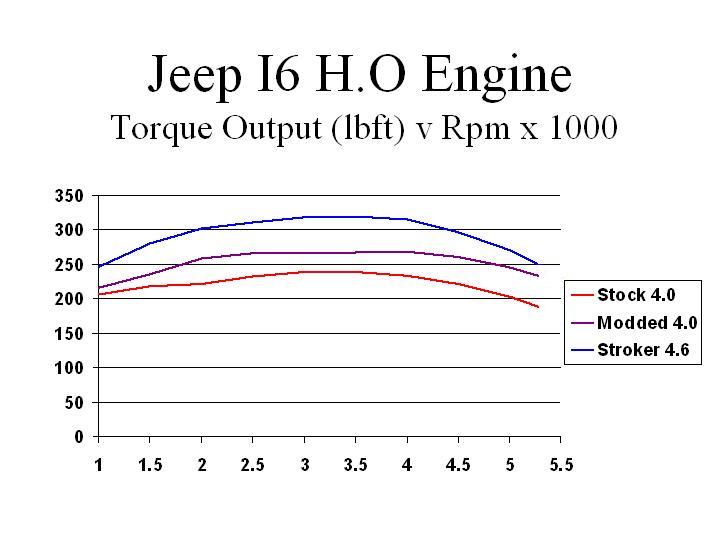
4.0 engine torque curves The torque curve of the engine in stock form was already broad and flat. The addition of some simple bolt-on performance modifications increased torque throughout the rev range, particularly at higher revs. Maximum horsepower increased from 193hp @ 4750rpm to 235hp @ 5100rpm, and maximum torque from 239lbft @ 3500rpm to 269lbft @ 3800rpm. The torque curve is broader, with at least 242lbft (1.0lbft/ci) available from 1600rpm to 5100rpm. This translates into faster acceleration at any speed in any gear making passing manoeuvres safer. Gas mileage remained the same despite the higher HP/TQ outputs thus reflecting the engine's greater efficiency. |
|
|
|
|
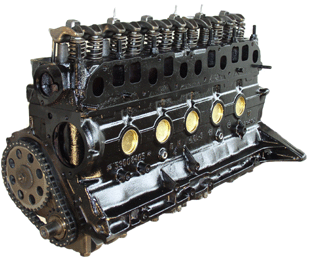
| Budget stroker build-ups Robert Bryce built the world's first budget Jeep I-6 stroker engine, reusing as many stock components as possible in his assembly to keep cost to a minimum. The key to success was to keep it simple. Click on the image to the right to find out more. Not to be outdone, I also jumped onto the stroker bandwagon and built the world's first "square" Jeep I-6 stroker engine with a bore and stroke of 3.895". It's identical to the 4.6L "poor man's" stroker shown below except that I used a Crane 753905 camshaft. I transformed a junkyard 4.0L short block plus a pile of parts into a rip-snorting torque monster with a displacement of 4563cc, hence I entitled my stroker story "From Junker to Stroker". |
 |
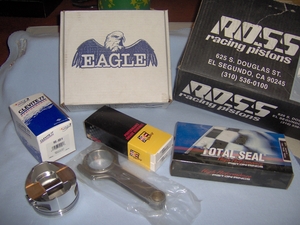 |
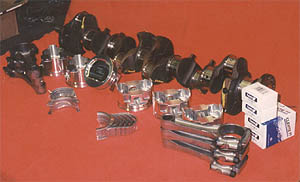
505 Performance stroker kit 505 Performance have introduced a range of stroker kits from mild to wild, including a 5.0L kit (actually 4855cc or 4.9L) with Ross Racing +0.060" forged pistons, 4340 H Beam Pro Series forged connecting rods, and a custom blueprinted 4.06" stroke crankshaft. They've also introduced a range of hydraulic flat tappet camshafts and they are the first company to introduce hydraulic roller tappet camshafts for the Jeep I6 engine.
|
| Hesco stroker kit
|
 |
 |
Other stroker kits
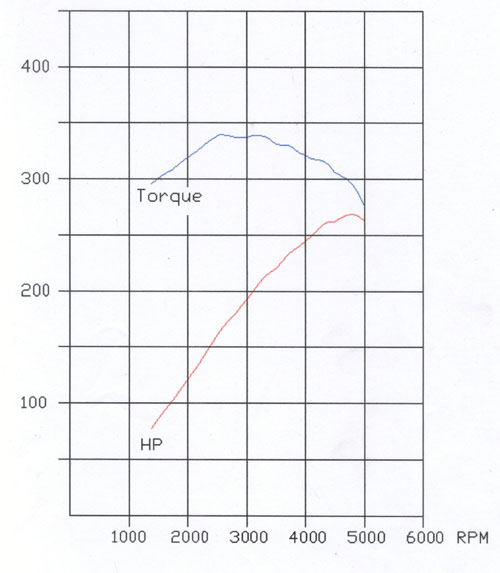
Limeyjeeper built the 4.0L engine from his '99 WJ into a 4.6L stroker engine using the Accurate Power stroker kit. It produced 210hp @ 4800rpm and 262lbft @ 3800rpm on the chassis dyno. Assuming a 20% drivetrain loss (RWD auto.), that's 263hp and 328lbft at the flywheel. Accurate Power, Speedomotive, and Jakes Racing Engines have ceased trading, while Clifford Performance continues to trade but no longer supplies stroker kits. |
| Injector sizing Stroker engines require oversize injectors to provide adequate fuel and prevent pinging due to lean air/fuel mixtures. Click on the image to the right. To calculate optimum injector size, use the following formula: Injector flow rate (lb/hr) = [Expected HP x 0.5 (BSFC)] / [no. of cylinders x 0.8 (injector duty cycle)] The actual injector flow rate from each injector depends on the fuel pressure (FP) in the injector rail. Most injectors have rated flows at 43.5psi fuel pressure. The actual flow rate from each injector is: Actual injector flow rate = Rated injector flow rate at 43.5psi x square root of (FP/43.5) |
 |
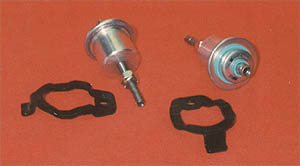 |
Adjustable fuel pressure regulator Fine tune your engine's fuel curve with a Hesco adjustable fuel pressure regulator (FPR). Click on the image to the left. The fuel pressure can be adjusted to provide the optimum air/fuel ratio. Part no. for the '87-'90 FPR is HES8790FR Part no. for the '91-'95 FPR is HES9195FR There is no adjustable FPR available for '96 and later engines. |
| Camshaft Stroker engines need a longer duration than stock camshaft to maximise horsepower and torque. Click on the image to the right to go to the CompCams catalog. The aim is to produce maximum torque over as wide an rpm range as possible. Stroker engines built with a compression ratio (CR) of about 9.5:1 will derive maximum benefit from a midrange camshaft such as the CompCams 68-231-4 206/214 degree cam. A stroker built to a CR of 8.8:1 that'll run with 87 octane fuel will benefit from a shorter duration dual-pattern cam such as the CompCams #68-115-4 192/200 degree cam for more low rev torque. |
 |
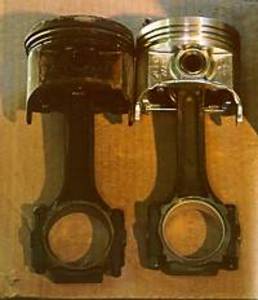 |
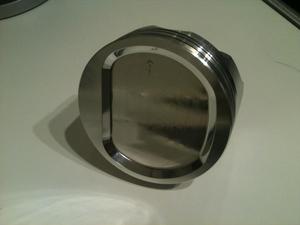
Long rods vs. short rods NEW: Keith Black have come to the rescue of the budget stroker crowd with reasonably priced, off-the-shelf ICON forged pistons that can be used with the stock Jeep 4.0L 6.125" rods so there's little reason to use the 0.25" shorter 4.2L rods in a stroker build anymore. The pin height of these pistons is 1.353" so that leaves the deck clearance at 0.027" (quench height at 0.070" with 0.043" head gasket) in a standard deck height block, and the compression ratio at 9.2-9.4:1 (depending on bore size) if you use the IC944 pistons with a 21cc dish. If you mill 0.020" from the block deck to reduce the deck clearance (and quench height), the compression ratio will increase by 0.4:1. |
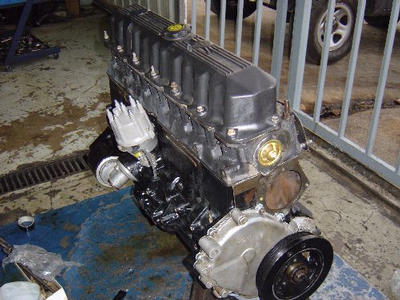
| Stroker engine math Here are some formulae, and how they apply to the stock Jeep 4.0L engine: 1. Deck height = Rod length + stroke/2 + piston pin height + deck clearance 9.453" = 6.125" + 1.705" + 1.601" + 0.022" 2. Combustion volume = Combustion chamber volume + head gasket volume + deck clearance volume + piston dish volume 84.6cc = 56.7cc + 10.5cc + 4.3cc + 13.1cc 3. Compression ratio (CR) = Cylinder volume/combustion volume + 1.0 CR = 660/84.6 + 1.0 = 7.80 + 1.0 = 8.80 4. Quench height = Deck clearance + compressed head gasket thickness 0.073" = 0.022" + 0.051" |
 |
 |
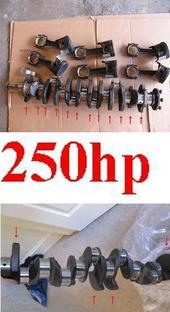
Stroker combinations I've outlined several stroker combinations from mild to wild below based on budget and desired horsepower levels. To get maximum benefit from the stroker engine you need a free-flow intake with an S&B or K&N cone filter, 62mm bored HO throttle body, header, high-flow cat, performance muffler and 2.5" exhaust piping. |
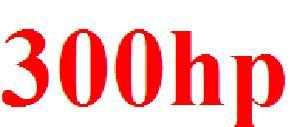
| 4.6L low-buck stroker Jeep 4.2L 3.895" stroke crank Custom forged +0.030" bore pistons, compression height 1.380", 5cc valve reliefs AMC 232 3.500" stroke crank |
 |
 |
4.7L medium-buck stroker Jeep 4.2L 3.895" stroke crank |
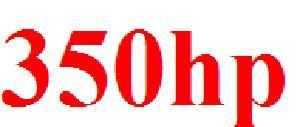
| 4.9L high-buck stroker Custom billet 4.06" stroke crank 5.0L very high-buck stroker Same as above except: Block resleeved to 4.00" bore diameter |
 |